Tangible Heritage
Monuments & Historic Structures
Armed Conflict
9 Steps
Protecting Historic Buildings During Armed Conflict: Quick Safety & Documentation Guide
Armed conflict can damage historic buildings through explosions, fire, looting, and sudden collapse. This guide shows safe, realistic actions you can take without putting yourself at risk: how to spot danger, document damage responsibly, prevent theft/looting, and report to the right people. Your safety comes first—never enter unstable structures or active conflict areas.
Applicable Phases:
Before
During
After
February 25, 2026
Introduction
Historic structures (monuments, bridges, old houses, ruins) are vulnerable during armed conflict because:
-Blast waves & vibrations can crack walls, arches, domes, and foundations.
-Fire & smoke weaken materials (wood, stone, mortar) and destroy interiors.
-Looting & vandalism increase when security breaks down.
-Improvised repairs can cause long-term harm (wrong cement, drilling, cleaning with chemicals).
-This guide focuses on non-expert, community-friendly actions:
-Observe from safe distance
-Collect evidence (photos, short notes, location/time)
-Protect information (don’t publicly share sensitive details)
-Report to local authorities / heritage teams / trusted NGOs
-If you have professional training, coordinate only through official channels.
-Blast waves & vibrations can crack walls, arches, domes, and foundations.
-Fire & smoke weaken materials (wood, stone, mortar) and destroy interiors.
-Looting & vandalism increase when security breaks down.
-Improvised repairs can cause long-term harm (wrong cement, drilling, cleaning with chemicals).
-This guide focuses on non-expert, community-friendly actions:
-Observe from safe distance
-Collect evidence (photos, short notes, location/time)
-Protect information (don’t publicly share sensitive details)
-Report to local authorities / heritage teams / trusted NGOs
-If you have professional training, coordinate only through official channels.
Do's and Don'ts
Do's
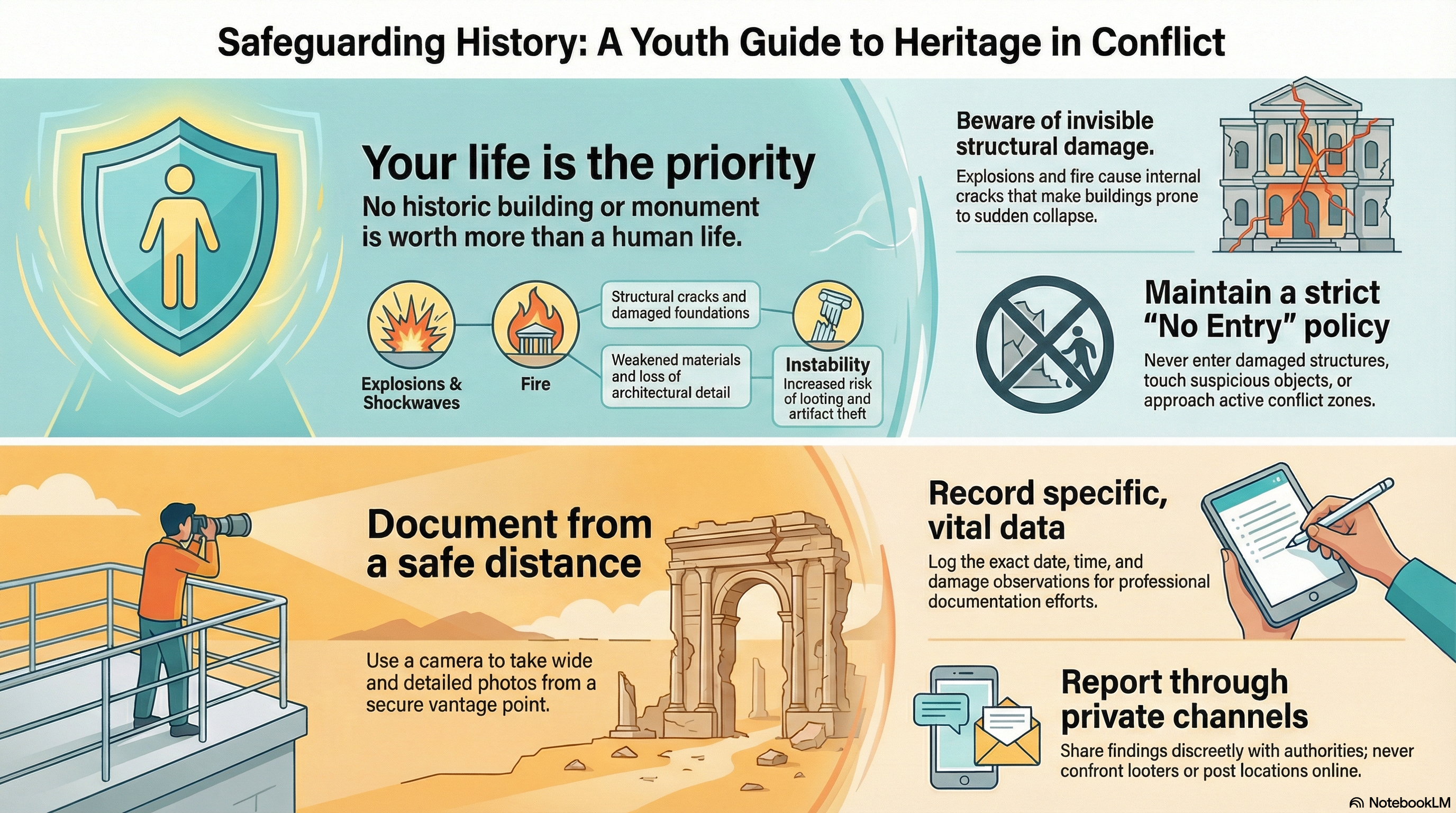
- Stay safe first: keep distance, follow local alerts, avoid military areas.
- Document from outside: wide shots + close-ups (if safe), include date/time.
- Record key details: what, where, when, visible damage, any immediate hazards.
- Share info privately with authorities/heritage professionals—not publicly.
- Secure small movable items only if you are authorized and it is safe/legal.
- Use basic PPE if near debris: sturdy shoes, gloves, mask (only in safe zones).
- Coordinate with local municipality, heritage directorate, museum, or trusted NGO.
Don'ts
- Don’t enter damaged/unstable buildings (collapse risk).
- Don’t remove artifacts without permission (legal risk + loss of context).
- Don’t post exact locations of valuable objects online (increases looting).
- Don’t touch unexploded ordnance or suspicious items—leave immediately.
- Don’t “clean” or repair with chemicals/cement/tape (can permanently damage).
- Don’t confront looters—report discreetly.
Video
Safeguarding_Our_Past.mp4
30.7 MB
Audio
Saving_History_Without_Being_a_Hero.m4a
10.3 MB
Step-by-Step Guide
9 Steps
Progress:
0/9
1
Check Safety & Get Updates
Description: Confirm the area is safe. Follow official warnings. If there is active fighting, do not approach the site. Identify safe observation points.
Phase: During
High Priority
Est. time: 10–20 min
Req. Resources: Phone, local alert channels, basic map/GPS
2
Observe from a Safe Distance (No Entry)
Description: Look for immediate hazards: leaning walls, fresh cracks, falling stones, smoke, fire, exposed wires, or blocked roads. Keep people away if possible.
Phase: During
High Priority
Est. time: 10–30 min
Req. Resources: None (optional: binoculars)
3
Quick Damage Documentation (Photo + Notes)
Description: Take wide-angle photos (whole building) + detail photos (cracks, holes, burned areas) from safe angles. Write short notes: date/time, exact place, what happened, what you see.
Phase: During
High Priority
Est. time: 20–45 min
Req. Resources: Phone/camera, notes app, GPS/location on
4
Protect Sensitive Info (Anti-Looting Rule)
Description: Do not share location of entrances, storage rooms, or valuable objects publicly. If you must share, do it privately with trusted authorities/heritage teams.
Phase: During
High Priority
Est. time: 5–10 min
Req. Resources: Secure messaging / email
5
Report to Authorities / Heritage Professionals
Description: Send a short report: where, what type of site, damage level, photos, urgent risks (fire, collapse, looting). Ask for professional assessment.
Phase: After
High Priority
Est. time: 15–30 min
Req. Resources: Contact list (municipality, heritage directorate, museum, NGO)
6
Simple “Perimeter Safety” Actions (Only If Safe & Allowed)
Description: If you have permission, place basic warnings (tape/sign) to keep people away from unstable areas. Never block emergency access.
Phase: After
Medium Priority
Est. time: 30–60 min
Req. Resources: Warning tape/signs, flashlight
7
Prevent Water & Weather Damage (Temporary Measures)
Description: If professionals approve, cover exposed openings (roof holes/windows) with non-invasive temporary covers to reduce rain/wind damage.
Phase: After
Medium Priority
Est. time: 1–2 hours
Req. Resources: Tarpaulin, rope, sandbags (no drilling/no glue)
8
Community Watch & Safe Monitoring Plan
Description: Organize a safe rotation with trusted adults/officials to monitor the site and report suspicious activity. Keep logs (date/time/observation).
Phase: After
Medium Priority
Est. time: 1–2 hours + daily 10 min
Req. Resources: Volunteer list, simple checklist, contact channel
9
Recovery Support (Data + Story, Not Risk)
Description: Help professionals with整理: rename photo files, map damage points, collect historical photos (before/after), and support awareness campaigns without revealing sensitive details.
Phase: After
Low Priority
Est. time: 1–3 hours
Req. Resources: Laptop/phone, shared folder, template form
All Steps Completed!
Great job! You've completed all steps in this action guide.
Share this Action Guide
Help others learn about heritage protection!